
Angelo Mangiarotti: the design that transformed the bathroom into architecture


There are designers who follow trends, and then there are authors who manage to make them irrelevant. Angelo Mangiarotti belongs to the second category: his work continues to speak to those seeking spaces that are essential, material-driven, and destined to last over time. For anyone designing or renovating a bathroom, the real issue is not simply choosing a beautiful washbasin, but finding an element capable of giving identity to the entire space. This is where the value of his approach comes into play: pure forms, architectural balance, and an exceptionally strong relationship with the material. Understanding the language of architect Angelo Mangiarotti today means understanding why some of his projects are still a reference point in the contemporary bathroom.
Who was Angelo Mangiarotti
Angelo Mangiarotti was one of the great protagonists of twentieth-century Italian design and architecture. Born in Milan in 1921, he built a design path capable of moving between architecture, industrial design, and research into form with a rare coherence. Even today, his name is associated with an idea of design that is rigorous, concrete, and deeply tied to materials.
Talking about Mangiarotti Angelo therefore does not simply mean making a historical reference. It means entering a way of designing in which every element has a precise reason: form is not decoration, but the consequence of function, material, and the space in which the object lives.
And this is precisely why his work continues to be so relevant in bathroom furnishings as well: because it responds to a very contemporary demand, that of spaces that are essential but not cold, sophisticated but not excessive.
What was Angelo Mangiarotti’s style
When speaking of Angelo Mangiarotti design, there are certain traits that always return and immediately help explain the strength of his language.
True essentiality, not superficial minimalism
Mangiarotti works by subtraction. His forms are clean, legible, never weighed down by unnecessary details. But this essentiality is never empty: behind every line there is always a constructive logic.
Material as the protagonist
In his design, material is never a simple covering. Marble, stone, and textured surfaces are not used to “embellish,” but to build presence, volume, and character.
A balance between function and sculpture
One of the most interesting aspects of his work is precisely this: his objects are functional, but they always have a very evident plastic and architectural strength. They never seem like accessories placed there just to complete a space. They seem like necessary parts of it.
In concrete terms, Angelo Mangiarotti’s style can be summarized as follows:
- pure forms;
- very controlled proportions;
- materials enhanced for what they are;
- elegance without excess;
- strong architectural presence.
Why his design is still relevant in the contemporary bathroom
Those renovating a home today are increasingly looking for a bathroom that will not seem “dated” after just a few years. They want continuous surfaces, authentic materials, timeless colors, and pieces with personality that do not feel intrusive.
This is exactly where Mangiarotti’s design continues to work.
In the contemporary bathroom, his language is appreciated because:
- it places material at the center;
- it dialogues well with large slabs and elegant cladding;
- it enhances both minimalist settings and more material-rich spaces;
- it transforms the washbasin into a central element of the project.
From design vision to bathroom products
To truly understand his washbasins, one must start here: the bathroom projects signed by Mangiarotti were not born as stylistic exercises, but as coherent applications of his way of thinking about space.
When his language meets the world of the bathroom, the result is very clear: material becomes form, form becomes architecture, and the washbasin ceases to be a secondary accessory.
It is precisely in this transition that his projects for Agape fit in, a brand that translated this vision very effectively into a series of washbasins that have now become iconic: Bjhon 1, Bjhon 2, Lito 1, Lito 2, and Lito 3.
Here the value of Angelo Mangiarotti’s design can be seen concretely. We are no longer speaking only about design theory, but about objects that truly help build a stronger, more recognizable, and more coherent bathroom.
Angelo Mangiarotti’s projects for Agape
Bjhon and Lito: when the washbasin becomes the protagonist
The Bjhon and Lito families are among the most interesting expressions of the relationship between design, material, and architecture applied to the bathroom. They are very different washbasins, but they share the same quality: they do not merely occupy a space, they define it.
Bjhon 1: the sculptural washbasin
Bjhon 1 is probably one of the models that best represents the sculptural strength of Mangiarotti’s work. The washbasin develops around a truncated-cone column that supports the basin and creates an immediate, strong, almost monumental presence.
It is the right product for:
- a bathroom with a strong identity;
- a protagonist washbasin;
- a design capable of enhancing marble, stone, and significant cladding.
Bjhon 1 works very well in master bathrooms and in all those contexts where the washbasin must play a central role.
Bjhon 2: greater compositional freedom
Bjhon 2 maintains the same formal intensity as the family, but introduces greater freedom during the design phase. It is the ideal solution for those who want an iconic object but with more compositional possibilities, both from the point of view of installation and in dialogue with the faucets.
It is particularly suitable when there is a need for:
- a contemporary bathroom that is not predictable;
- a freer composition;
- a washbasin with a strong sign, yet versatile.
Bjhon 2 is very useful when looking for a design piece with personality without it feeling too rigid.

Lito 1: carved marble becomes architecture
With Lito 1, the theme changes: here the material becomes even more of a protagonist. The washbasin seems to emerge directly from the block, as if it had been carved out and brought to its essence. The result is a monolithic, architectural, and highly refined object.
It is the right choice for those who want:
- a material-focused washbasin;
- a strong yet elegant presence;
- a bathroom in which marble has a structural role, not merely a decorative one.
Lito 1 is perfect for high-end residential projects, especially when the goal is a bathroom that is understated yet highly authoritative.
Lito 2: the designer hand basin
Lito 2 is proof that even a more compact format can have a precise identity. It is a hand basin that retains all the formal quality of the collection, while translating it into a more agile solution.
It is ideal for:
- guest bathrooms;
- powder rooms;
- compact spaces that deserve to be enhanced;
It is a very interesting proposal because it makes it possible to raise the level of the project even when the available space is limited.
Lito 3: strong character even in a small space
Lito 3 continues the same line of thought, but with an even more dynamic character. It has more decisive lines and a highly recognizable personality, which makes it perfect for those who do not want to give up design even in a small or secondary bathroom. Lito 3 demonstrates that even a compact space can become memorable.

Differences between Bjhon and Lito
The Bjhon family is more suitable when the goal is:
- a washbasin with strong visual impact;
- a very marked sculptural presence;
- a bathroom in which the washbasin becomes the focal point of the project.
Bjhon is ideal for more dramatic settings, for master bathrooms, and for those who want an object that is immediately recognizable.
The Lito family is more suitable when looking for:
- a more direct relationship with the material;
- a monolithic aesthetic;
- a bathroom that is more architectural than dramatic.
Lito works very well in contexts where a quieter, yet still very strong, elegance is desired.
FAQ
Who was Angelo Mangiarotti?
Angelo Mangiarotti was one of the most important Italian architects and designers of the twentieth century. His work spanned architecture, design, and research into form, leaving a profound mark also in the world of bathroom furnishings.
What was Angelo Mangiarotti’s style?
Angelo Mangiarotti’s style combined essentiality, design rigor, attention to function, and a strong enhancement of material. His forms are clean, but never cold; materials are protagonists, not simple finishes.
What are the best-known Agape projects designed by Angelo Mangiarotti?
Among the best-known projects designed by Angelo Mangiarotti for Agape are Bjhon 1, Bjhon 2, Lito 1, Lito 2, and Lito 3, washbasins that helped redefine the idea of the designer bathroom.
What is the difference between Bjhon and Lito?
The Bjhon family has a more sculptural presence and a more central role in the space. The Lito family, on the other hand, focuses on a more material-driven and monolithic reading, with a very strong relationship between volume and surface.
Are Lito washbasins also suitable for small bathrooms?
Yes, especially Lito 2 and Lito 3 are very suitable for guest bathrooms, powder rooms, and more compact spaces. They have more manageable dimensions but retain a strong design identity.
Conclusion
To tell the story of Angelo Mangiarotti properly means starting from his design, his rigor, and his relationship with material. Only in this way do his bathroom projects gain the weight they deserve. Bjhon 1, Bjhon 2, Lito 1, Lito 2, and Lito 3 are not simply beautiful washbasins to look at: they are objects that transform the bathroom into a more architectural, more coherent, and more memorable space.
-
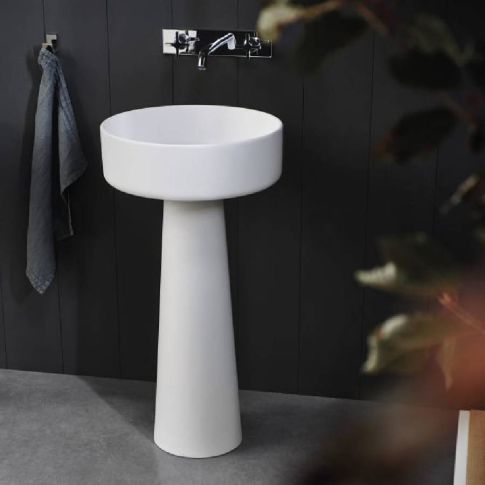 Agape Bjhon ACER1081M Freestanding BasinAs low as €2,061.00 Regular Price €2,748.00
 -
 Agape Bjhon 1 ACER1083 Countertop BasinAs low as €795.00 Regular Price €1,060.00
 - Agape Bjhon 2 ACER1084 Countertop BasinAs low as €1,293.00 Regular Price €1,724.00
- Agape Bjhon 2 ACER1082M Freestanding BasinAs low as €2,635.50 Regular Price €3,514.00
- Agape Lito 1 ACER0731 Freestanding BasinSpecial Price €6,876.00 Regular Price €9,168.00
- Agape Lito 2 ACER0732 Freestanding BasinAs low as €6,591.75 Regular Price €8,789.00
- Agape Lito 3 ACER0733 Freestanding BasinSpecial Price €7,896.00 Regular Price €10,528.00


About the Author


